

For Part 1 covering Eastern Orthodoxy, go here.
Roman Catholic
History
The history of the Roman Catholic Church largely mirrors that of the Eastern Orthodox Church until the Great Schism of 1054. However, that history, told from a Roman Catholic perspective, would have one very major difference. As the Byzantine Empire and the Eastern Church patriarchies underwent political, economic, and military decline, the Roman Bishop assumed sole authority over the Western Church and eventually, the whole of Christendom.
In the second and third centuries, theologians such as Irenaeus of Lyons, Cyprian of Carthage, and Clement of Rome developed the idea that the Bishop of Rome inherited apostolic authority from the Apostle Peter. Through a slow process, popes (i.e., Rome’s bishops) took greater unilateral authority. Add to this the development of separate liturgies, church aesthetics, cultural differences, and economic disputes, and the Western Church saw itself as distinctly separate and superior to the Eastern Church. Pope Innocent I (401-417) and Pope Leo I (the Great, 440-461) both produced edicts claiming greater doctrinal, ecclesiastical, and political authority. In 1215, the Fourth Lateran Council reaffirmed that authority.
Three hundred years after the Great Schism, the Roman Catholic Church had to work through another separation with the Protestant Reformation. In response to the Reformation, the Council of Trent (1545-1563) reaffirmed the Pope’s ecclesiastical authority, as well as reaffirming specific doctrines such as the seven sacraments, transubstantiation, the Latin Vulgate as the authoritative version of Scripture, purgatory (which was rejected by both Protestants and Eastern Orthodox), and other church reform issues. The First Vatican Council (1869-1870) solidified Papal primacy over the church. The Pope can speak ex cathedra, or from the chair of Peter, infallibly. This has been done twice: Pope Pius IX in 1854 (Mary’s Immaculate Conception) and Pope Pius XII (Assumption of Mary).
As the Roman Catholic Church entered the Twentieth Century, it found itself with far less political influence. With World War 1 and 2, the church had to navigate its way through Fascism, Communism, holocaust, economic upheaval, and a plethora of other geopolitical issues and catastrophes. In the shadow of World War 2 and in the heat of the Cold War, the Second Vatican Council (1962-1965) was called by Pope John XXIII and concluded by Pope Paul VI. This was the widest update to the Roman Catholic church ever. The goal was to engage with the world, not withdraw from it. In that, the Council addressed ecumenism (bringing other faith traditions into reunification), the renewal of church doctrines with updated language, and the expansion of the faith to all peoples. Most significantly, the Mass was no longer restricted to Latin but could be conducted in local languages. Scripture was also linguistically localized and encouraged all Catholics to engage with reading the Word of God. These are but a few of what Vatican 2 addressed, and the effects of the council reverberate to this day.
Leadership
The leadership structure of the Roman Catholic Church is hierarchical. At the top is the Bishop of Rome, the Pope, who is the successor of the Apostle Peter and the leader of the entire Christian Church, as assigned by Christ in Matthew 16:13-19. Underneath the Pope is the College of Cardinals. These are bishops appointed by the Pope. Their main responsibilities are advising popes, leading major dioceses, running the Vatican (in Rome, the center of Roman Catholicism, where the Pope resides), and electing new popes.
Next are the Episcopate, bishops who lead local dioceses across geographical territories worldwide. Priests are under bishops and serve local parishes. All Cardinals, bishops, and priests are ordained, can only be men, and cannot be and must remain unmarried. Also serving the local parish are Deacons who are ordained and can be married men. They serve the local parish with Gospel proclamation, preaching, distributing Eucharist, and assisting the priest during Mass and other liturgical functions.
Laity in the Roman Catholic Church plays an increasingly important role in local parish life. Roles for the laity are open to both men and women. Examples of these roles include eucharistic ministers, lectors (reading non-Gospel Scripture), altar servers (frequently middle- to high-school-aged minors), catechists (teaching catechism), parish administrators, and more. The number of deacons and priests is limited, which demonstrates the essential need for lay activity in local parish life.
Major Doctrinal Distinctives
Doctrinally, the Roman Catholic Church’s distinctives start with how doctrine is decided. Sacred Tradition and Sacred Scripture are equal in authority when deciding doctrine.[1] Both are Holy Spirit-inspired. Therefore, the tradition of Apostolic Succession and the authority of the Pope weigh heavily in Catholic doctrine.
Decisions on doctrine for the Catholic Church follow several paths. The Magisterium (selected bishops in communion with the Pope) is the primary source of dogma.[2] However, when the Pope speaks ex cathedra or an ecumenical council convenes, dogma and doctrine can be revised, updated, and/or added to the church. Roman Catholics hold that their spiritual life and the dogmas of the Church have an “organic connection,” and the Catholic’s “intellect and heart will be open to welcome the light, shed by the dogma of faith.”[3]
Having stated that, one of the dogmas of the Roman Catholic Church is the concept of Purgatory. Purgatory is “final purification of the elect” after death, which is “necessary to enter the joy of Heaven.”[4] There are two effects of sin: temporal and eternal. Temporal punishment is the effect of sin, even though sin has been forgiven.[5] Eternal punishment is complete separation from God and is forgiven at the sacrament of Reconciliation.[6] Thus, Purgatory is a necessary spiritual cleansing before the believer enters eternity.
Related to Purgatory is the practice of praying for the dead and indulgences. Catholics pray for those who have died in order to help them in their time in Purgatory.[7] Like the Orthodox, Catholics believe that death does not separate the body of Christ and that people can pray to or for (Orthodox would say pray with) those who have died. Praying for a person in Purgatory can have meritorious effects. Indulgences, which are actions that are a “remission before God of the temporal punishment due to sins whose guilt has already been forgiven.”[8]
Lastly, but certainly not finally, is the place of Mary, the mother of Jesus, in Roman Catholic theology. Mary was immaculately conceived, meaning she was born “in Christ” and was “redeemed in a more exalted fashion” at the time of her conception.[9] She remained sinless and remained a virgin throughout her life. Up until recently, the term “co-redemptrix” (co-redeemer along with Jesus) was used to describe Mary’s role in salvation. However, Pope Leo XIV clarified that the term was inappropriate and the term Mediatrix was more appropriate as Mary mediates for all believers.[10]
Sacraments
Like the Eastern Orthodox, Roman Catholics recognize the seven sacraments (mentioned above). However, there are some differences in how Catholics approach the sacraments. Notably, influenced by the Scientific Revolution (approximately 1543-1687 CE) and the Enlightenment, Roman Catholic theologians sought to explain what the Orthodox would consider inexplicable. For instance, Thomas Aquinas, when covering the eucharist in his Summa Theologica Q. 75, used Aristotelian language to describe the “essence” and “accidents” of bread and wine as the body and blood of Jesus. In Roman Catholicism, there is a rich culture of theological and sacramental explanation. But these explanations do reach their end in mystery at some point, with even Aquinas stating that his writings were “like straw” compared to the heavenly mysteries yet to be discovered.
With that stated, the sacraments of Reconciliation and the Eucharist are central to Catholic life. The Catholic Mass is the liturgical celebration culminating in the Eucharist. Prior to celebrating Mass, the Catholic participates in the sacrament of Reconciliation, in which they typically go to a booth and confess their sins anonymously to a priest. The priest will grant the penitent absolution and assign them some form of penance (a type of indulgence), a voluntary act that removes the temporal punishment for sin and allows for full participation in the Mass.[11]
Historical and Contemporary Spiritual Formation Practices
Roman Catholicism has a deep well of spiritual formation practices. From Franciscan, Dominican, Jesuit, and other spiritual communities, different practices and emphases guide the Catholic into the richness of spiritual formation. For instance, the spiritual discipline of poverty and simplicity practiced by the Franciscans continues to this day in communities such as the Little Portion Hermitage in Arkansas. The spiritual disciplines of Scripture study and theological engagement continue at Jesuit institutions, colleges, and universities. To that, Catholic mystics and thinkers, modern and ancient, have contributed to the formation of Catholic believers. Catherine of Sienna, St. Bonaventure, and Julian of Norwich stand side by side with Henri Nouwen, Thomas Merton, and Peter Kreeft.
Also important to many Catholics is devotion (not worship) of Mary, the mother of Jesus. Through devotional practices such as novenas, praying the rosary, and others, Catholics use devotion to Mary to be closer to her son, Jesus. There are also pilgrimage sites dedicated to visitations from the Virgin Mary. Lourdes, Fatima, Medjugorje, and La Sallette are some of those pilgrimage sites.
Lastly (though not finally, as Catholic spiritual practices seem endless), there is eucharistic devotion. Roman Catholics believe that the elements of the eucharistic ceremony become, in essence, the body and blood of Christ. Most churches have a special place near the altar where they put a piece of the host (bread – body of Christ) on display. Catholics can spend time in prayer and adoration of Jesus, believing in the actual presence of Jesus. It is a way for Catholics to increase their faith, bring specific petitions, or just sit in the presence of their Savior.
Protestant
History
On October 31, 1517, CE, Martin Luther, an Augustinian monk and priest, posted on the door of All Saints Church in Wittenberg, Germany, a list of ninety-five propositions he thought very reasonable. These propositions were in reaction to the selling of indulgences to the people as a way to pay for the construction of St. Basil’s Cathedral in Rome. The document called for the Church and the Pope to return to Scripture as the authority by which doctrine hung. Thus began the journey that led Luther to Worms, Germany, in 1520 CE. Pope Leo X issued his bull (a papal announcement or proclamation) entitled Exsurge Domine (Arise Lord), which addressed the errors in the Ninety-Five Theses. Emperor Charles V called a Diet (a formal trial) in which Luther was judged by his writings. On April 17, Luther was ordered by the Diet to recant all of his writings. Luther struggled and asked for a day to think and pray about this demand. On April 18, he was summoned again to recant his works. He gave a short speech and finished that speech with the now famous words: “Unless I am convinced by the testimony of the Scriptures or by clear reason… I cannot and will not recant anything, since it is neither safe nor right to go against conscience. May God help me. Amen.”[12] Thus began the German Protestant Reformation. Along with Luther, other notable reformers such as Jean Calvin, Ulrich Zwingli, and Philipp Melanchthon brought a new wave of Christian thinking that placed Scripture above the Pope, the Church, and tradition.
In England, Henry VIII was frustrated that his wife, the Spanish Queen Catherine of Aragon, was not producing male heirs. His spiritual counselor, the Archbishop of Canterbury, Thomas Cranmer, built a case for annulment of the marriage in 1533 CE, but Pope Clement VII denied that request. In 1534 CE, Henry released two ordinances: The Ecclesiastical Appointments Act and the Act of Supremacy. These two acts, along with The Treasons Act (which made failure to adhere to the Act of Supremacy a capital act of treason), began the English version of the Protestant Reformation.
In the centuries since Luther and Henry, the Protestant Reformation can be marked by two common themes: growth and diversification. John Knox, a follower of Calvin, brought Swiss Reformation theology to Scotland, which influenced the Puritans who brought Protestantism to North America. The great 19th-century missionary movement spread Protestant Christianity to China, India, Africa, and the ends of the Earth.
At the same time, many different Protestant groups developed into denominations. Charles Wesley’s Methodism, Knox’s Presbyterianism, and Menno Simons Anabaptist movements had their child and grandchild movements in Pentecostalism, North American Baptist, Christian and Missionary Alliance, Reformed Evangelical, Congregational, and many more. Protestant denominations and independent non-denominational churches have grown and flourished worldwide.
Leadership
With the diversity of Protestant denominations and churches, there has also been a diversity of leadership structures. Some, like Episcopalian/Anglican, Methodist/Wesleyan, and Lutheran churches, hold to a Protestant form of apostolic succession with bishops (or superintendents) and church councils that have authority over local districts and churches. Others, such as independent Evangelical and Pentecostal/Charismatic churches and denominations, have leadership structures entirely within the local church, with the local pastor having the highest authority, or joint authority with a local church council (or Board of Elders). Others, such as Congregational churches, are entirely run by congregational authority. All decisions are ratified by congregational ascent.
Major Doctrinal Distinctives
Like Protestant leadership, doctrine is also a moving target. Ubiquitous to most protestant churches is the concept of the universal, invisible church. Christ’s body of believers is not located in Rome or in any of the Orthodox Patriarchies. It is universal among all believers, invisible in structure, but is seen with the gathering of believers together.
Reformation-based denominations stress the five solas of the early reformation. Sola Scriptura, sola Fide, sola Christos, sola Gracia, and sola Deo Gloria point out that Scripture is the main authority for doctrine and that the grace of Christ, in faith, is what saves humans to God’s glory. Further, with Calvin’s influence, most Reformed-affirming churches adhere to a version of predestination where some people are preselected before time for salvation, and others are not.
Other churches, such as Pentecostal/Charismatic and Wesleyan, stress the importance of personal holiness and personal responsibility for accepting the gift of God’s grace of salvation through Jesus. Pentecostal/Charismatic churches also have distinctives that emphasize the “supernatural” gifts of the Holy Spirit. Their services and spiritual lives are marked by speaking in tongues, prophecy, healings, and deliverances.
Sacraments
Again, diversity is the common trend among Protestants and the sacraments. Some of the more dispensationalist and fundamentalist Protestant churches would recoil at the word “sacrament.” These churches would see them as memorials or outward signs.
Protestants generally recognize two sacraments. Here, too, there is diversity. In baptism, there are infant baptizers such as Anglican/Episcopalian, Lutheran, Presbyterian, Methodist, and others. Southern Baptists, Evangelicals, Pentecostal/Charismatics all generally recognize believer baptism. As far as Eucharist (or communion or the Lord’s Supper), some churches, such as Lutherans and Episcopalian/Anglican, believe in a form of consubstantiation – Jesus is present in the wine (or grape juice) and bread, but the substances do not change. Other churches, such as Southern Baptists, Evangelicals, and Pentecostals/Charismatics, see the ceremony as a memorial to the death and atonement of Jesus.
Historical and Contemporary Spiritual Formation Practices
Scripture is the focal point for most Protestant churches.[13] While the Eucharist is the focal point of Roman Catholic and Eastern Orthodox services, the sermon is the focal point for most Protestants. The preaching of Scripture and the unfolding of the truth of Scripture have preeminence for most protestants. Expanding on the Sunday Sermon is further adult education and personal spiritual devotional time – all focused on Scripture.
Pentecostal/Charismatics would also include Scripture reading and proclamation in their services and devotional life, but they would also incorporate ministry time with prayers of healing, intercession, and prophecy with a heavy dose of speaking in tongues throughout. Wesleyan/Methodists have their Means of Grace, which are sanctifying activities of personal and corporate holiness. Lately, with the writings of Richard Foster and Dallas Willard, interest in the classic [14]spiritual disciplines have become increasingly popular among Protestants.
Conclusion
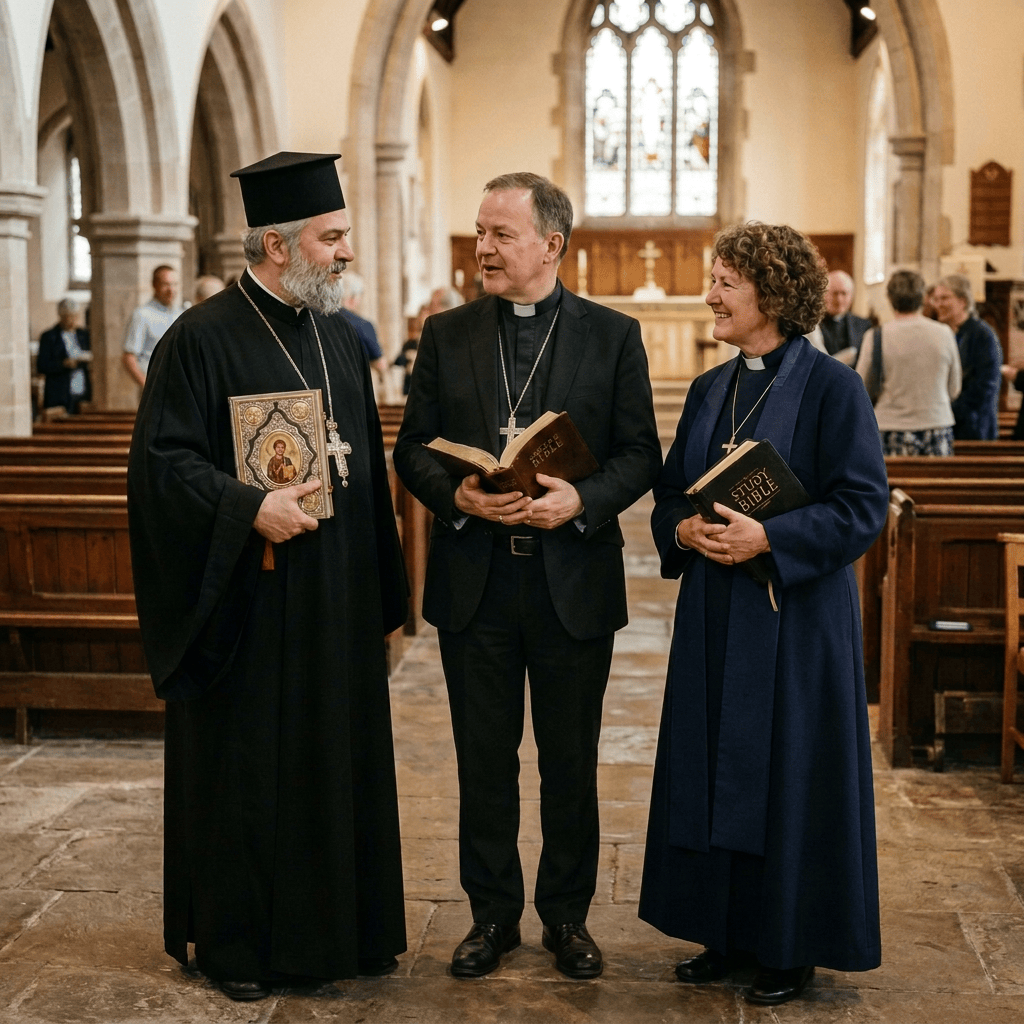
Three streams within the wide river of the Christian faith are heading towards the eventual return of Jesus and the establishment of his Kingdom. Eastern Orthodox, Roman Catholic, and Protestant Christians all have much to learn from one another. None of them is siloed in history. All share the common triumphs, tragedies, atrocities, and acts of benevolence of the Christian church. God delivered his Holy Spirit to people, and his people are messy. But they are also His image. Even though Christians differ in doctrine and practice, they are all sailing on the same stream of Christianity’s great river.
[1] Catholic Church, ed., Catechism of the Catholic Church: With Modifications from the Editio Typica, 2nd ed., [new] (Doubleday, 1997), 31.
[2] Catholic Church, Catechism of the Catholic Church, 33.
[3] Catholic Church, Catechism of the Catholic Church, 33.
[4] Catholic Church, Catechism of the Catholic Church, 291.
[5] Catholic Church, Catechism of the Catholic Church, 411.
[6] Catholic Church, Catechism of the Catholic Church, 411.
[7] Catholic Church, Catechism of the Catholic Church, 272.
[8] Catholic Church, Catechism of the Catholic Church, 411.
[9] Catholic Church, Catechism of the Catholic Church, 138.
[10] “Doctrinal Note on Marian Titles: Mother of the Faithful, Not Co-Redemptrix – Vatican News,” November 4, 2025, https://www.vaticannews.va/en/vatican-city/news/2025-11/doctrinal-note-mother-of-the-faithful-not-co-redemptrix.html.
[11] Catholic Church, Catechism of the Catholic Church, 411.
[12] Eric Metaxas, Martin Luther: The Man Who Rediscovered God and Changed the World (Viking, 2017), 216.
[13] Although progressive churches have shown a trend of late to deemphasize Scripture in favor of more universalist and unitarian spiritual practices.
[14] An interesting resource for this kind of spiritual discipline renewal is a podcast called The Sacramental Charismatic, which focuses on the increasing popularity of sacramental worship and spiritual disciplines within the charismatic Vineyard movement.
 The Wandering Wesleyan