

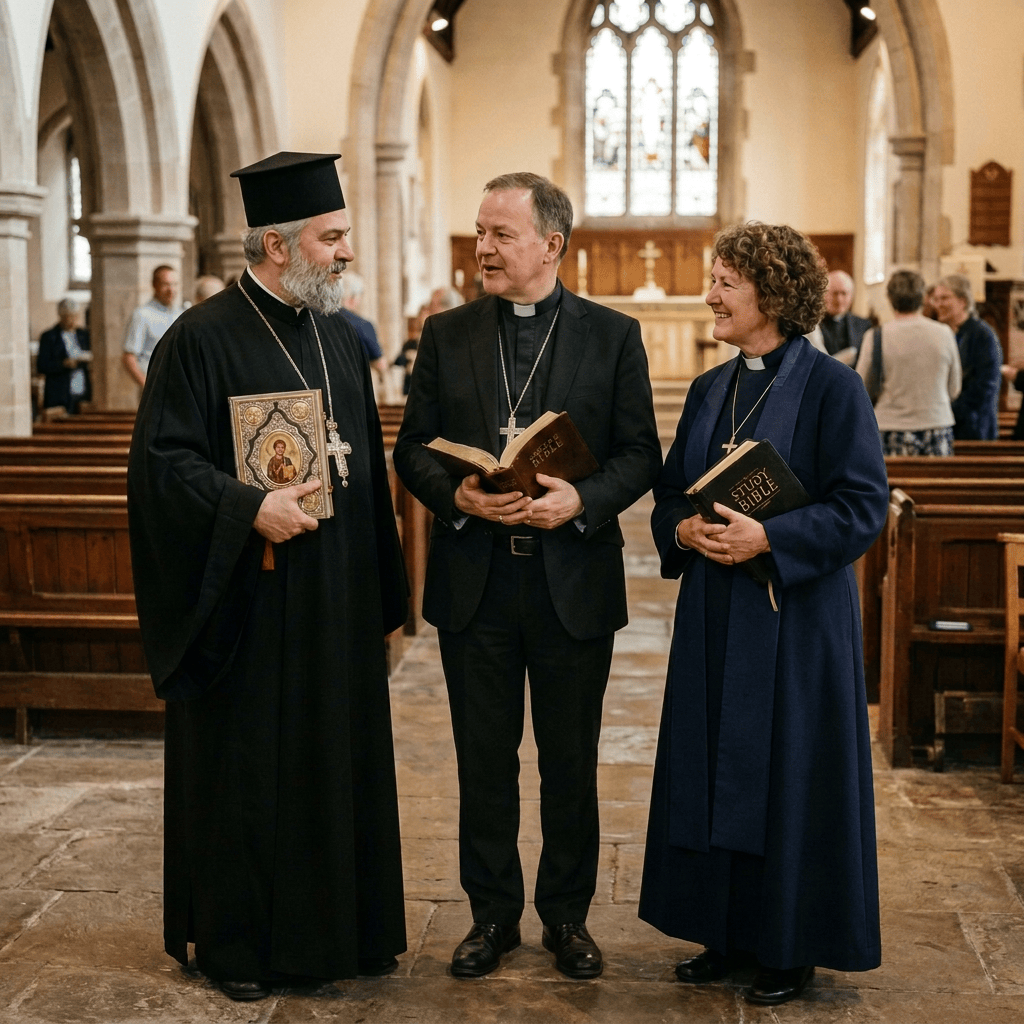
Introduction
This history of Christianity is marked by distinctives between different groups. In the first generation of Jesus’ followers, distinctives between Jewish and Gentile believers led to conflict and to the Jerusalem Council in Acts 15. Even more, one must suppose that there were cultural differences between the Churches of Galatia, Greece, and Rome, even though they were located in Gentile regions. Today, the different streams flourishing in the garden of the Christian faith have grown in their own and are marked by common dogma (that which is essential to be Christian) and disparate doctrines and practices.
This essay will reflect on the largest of the three streams of Christianity: Eastern Orthodox, Roman Catholicism, and Protestantism. Each stream adheres to the Nicaean Creed and the Apostle’s Creed. However, those creeds, while essential in describing orthodox trinitarian theology and Christology, leave ample room for other theological distinctives and spiritual practices.[1] The essay will review the history, leadership, major doctrinal distinctives, and sacraments, as well as historical and contemporary spiritual formation practices for the three streams.
Eastern Orthodox
History
The history of the Eastern Orthodox stream of the Christian faith begins with Acts 2. The early church, although marked by some differences between Gentile and Jewish believers, eventually grew beyond Jerusalem, spreading into the wider Roman Empire to Eastern Europe, Western Europe, Northern Africa, and parts of Western Asia. The church, initially persecuted by the Roman Empire, came to political and religious acceptance with the Edict of Milan in 313.
However, with that acceptance came the proliferation of heretical doctrines, mostly aimed at the divinity of Jesus. These doctrinal issues had been percolating under the surface during the time of persecution, but were brought into public discourse after the Edict. These heretical issues led to Ecumenical Councils that brought church leaders together to debate and settle doctrinal disagreements. The Eastern Orthodox Church recognizes the first seven Ecumenical Councils.
The first of these councils was the Council of Nicaea in 325, convened to settle the Arian heresy (Christ was not full God but was a created creature). During this council, the role of the Holy Spirit was not addressed, as there was an unresolved debate over whether the Spirit proceeded from both the Father and the Son or only from the Father (the issue of the word “filioque“). This issue was later resolved at the Council of Constantinople in 381, which affirmed the deity of the Holy Spirit and added a paragraph to the Nicaean Creed, without the filioque.
With the rise of Islamic military aggression through the seventh, eighth, and ninth centuries, the political and theological strength of the Eastern patriarchies (their leadership centers) declined. The Bishop of Rome began making arbitrary decisions without input from his Eastern brethren. Declarations such as the coronation of Charlemagne as Holy Roman Emperor (there was still an Eastern Byzantine emperor) in 800, the attempt to remove Photius as Patriarch of Constantinople in 858, and the adding of the filioque into the Nicaean Creed (with an insistence that the Eastern patriarchies follow suit) led to a great strain between East and West. Finally, in 1054, the Bishop of Rome, Pope Leo IX, and the Patriarch of Constantinople, Cerularius, excommunicated each other, causing the Great Schism between the Roman Catholic and Eastern Orthodox Churches.
Eastern Orthodox history is also marked by persecution. As the Islamic forces rolled through the Middle East, North Africa, and Eastern Europe, the Orthodox church went into various stages of decline and subservience. The sacking of Constantinople by the Fourth Crusade under Pope Innocent III in 1204 left the city and the patriarchy of John X Kamateros in shambles. This left the city open to the Ottoman Empire, which invaded it, ended the Byzantine Empire, and renamed it Istanbul in 1453.
With the weakening of the Eastern Christian world, the Orthodox became more regional. The Russian, Greek, Serbian, and other Orthodox churches emerged, each with its own patriarch and culturally based customs. With the demise of the Ottoman Empire, after World War 1, and the rise of the Communist Empire of the Soviet Union, the Eastern Orthodox church, except for most notably Greece, remained under persecution. Because Greek Orthodox Christians were not under the kind of restrictions as their brethren under Communist persecution were, they were able to move west to North America, taking their culture and their faith with them.
Leadership
Before the Great Schism, there were five major patriarchies: Constantinople, Rome, Jerusalem, Antioch, and Alexandria. With the Muslim/Ottoman conquest of all but Rome, those patriarchies became less important, and regional patriarchies dominated. A patriarch (or archbishop, bishop, or metropolitan) has ecclesiastical responsibility over a particular region and considers themselves as directly descended from the original apostles (Apostolic Succession). Bishops, or patriarchs, have threefold powers: ruling, teaching, and celebrating the sacraments.[2] He is not someone set up to be over the Church, but someone occupying an office ordained by God and safeguarding the faith.[3] Each patriarch in each region is in full communion with the others, and they are all considered the Body of Christ – One Church of God.[4]
At the local church level, there is the priest and the deacon. The priest is ordained by the patriarch, may be married, and is generally responsible for the liturgical and pastoral care of the local church. The deacon assists the priest, and unlike the patriarch and the priest, can be a woman.
Major Doctrinal Distinctives
Doctrinal authority in Eastern Orthodoxy is split into three ways. First, there is Sacred Scripture. No doctrine of the church can contradict Scripture, and major doctrines rest on Scripture. Second is tradition. Sacred tradition is derived from Jesus’ first apostles and kept intact through the ages. Third is the Ecumenical Councils. When the church finds herself in disagreement over doctrinal issues, she must come together and resolve those issues under the guidance of the Holy Spirit in ecumenical gatherings.
There are many doctrinal distinctives in the orthodox church. Of these distinctives, worship, icons, and mystery are central. For the Eastern Orthodox Christian, worship is the central part of a Christians life. All theology in thought and practice should lead one to worship. Using the liturgies of either St. John Chrysostom or St. Basil the Great, the eucharistic liturgical celebration is a time of immersion into worship. The Eastern Orthodox worshipper is not just worshipping in their local church with other Christians, but they are joining Christians throughout time and eternity in devotion.
Which leads to icons. Icons are paintings that are windows into eternity. Orthodox Christians do not worship icons, but they venerate (that is, show deep respect or honor) them because a properly painted icon of a historical figure (Jesus, Mary the Theotokos God-bearer, the saints) is a window into them in eternity. In Orthodox worship, the figures in the icons are worshiping with those gathered in the local church.
Lastly, mystery is a central theme of Eastern Orthodox theology. Theology is speaking of God, who is perfect and eternal, using finite, flawed human language from finite, flawed human minds. Therefore, there is much yet to be discovered. When engaging in Orthodox theological discourse, one can take comfort in the unknowable, as that represents mystery. It doesn’t mean the Orthodox theologian stops the discussion when mystery is discovered; rather, they contemplate and worship that God has still more for us to learn.
Sacraments
Worship and theology are important to the Orthodox Christian, and the end goal of both is the believer’s transformation into greater Christlikeness. Thus, the mysteries (what Eastern Orthodox call sacraments) focus on the transformation of the believer, ridding them of the sickness of sin and reflecting Jesus in who they are, what they do, and how they think. There are seven mysteries in the Orthodox Church: Baptism, Chrismation (or confirmation – the indwelling of the Holy Spirit), Eucharist, Metanoia (or Confession), Anointing of the sick, Marriage, and Ordination. All Orthodox Christians partake of the first five. Baptism, Chrismation, and Eucharist are all first given to infants (with the babies fully immersed in water for baptism) in the same ceremony. The eucharistic celebration involves transubstantiation – the elements of bread and wine becoming the body and blood of Jesus. Metanoia is not done in a private confessional but in person, face-to-face.
Historical and Contemporary Spiritual Formation Practices
Many of the historical devotional practices of Christians across all faith traditions find their root in the Orthodox church. Fasting, contemplation, scripture reading, solitary devotion, communal celebrations, and others all find their roots in the early church and remain relevant and in use to this day. As stated earlier, Orthodoxy is primarily concerned with worship and the believer’s transformation into deeper Christlikeness. Orthodox spiritual practices continue these themes.
Take, for instance, the Jesus Prayer. Usually, a thick rope or cord with thirty to one-hundred knots is used. As the prayer proceeds, the believer moves down each knot with slow, intentional breathing. As the believer breathes, they pray, “Lord Jesus Christ, have mercy on me, a sinner.” By praying the Holy Name of Jesus over and over, they center their minds on Jesus and his presence.[5] States McGuckin, “This is the divine name that carries within it the force of divine presence. Its invocation in the heart of the believer, and over the materiality of the cosmos itself, is a sacred consecration and inherent blessing.”[6] This is the attitude toward all spiritual disciplines within the Eastern Orthodox Church: the transformation of the believer, healing them of the sickness of sin, and bringing them into greater likeness to Jesus.
[1] For instance, the Nicaean Creed briefly touches on Pneumatology (with one, four-part sentence) and Ecclesiology (with one brief sentence) at the end of the creed, but is principally focused on Christology and establishing the Trinitarian nature of God.
[2] Timothy Ware, The Orthodox Church: An Introduction to Eastern Christianity, Third edition (Penguin Books, 2015), 241.
[3] Ware, The Orthodox Church, 243.
[4] Eve Tibbs, A Basic Guide to Eastern Orthodox Theology: Introducing Beliefs and Practices (Baker Academic, a division of Baker Publishing Group, 2021), 34–35.
[5] John Anthony McGuckin, The Orthodox Church: An Introduction to Its History, Doctrine, and Spiritual Culture, paperback ed. 1. publ (Wiley [u.a.], 2011), 337.
[6] McGuckin, The Orthodox Church, 337.


One Reply to “”