

Introduction
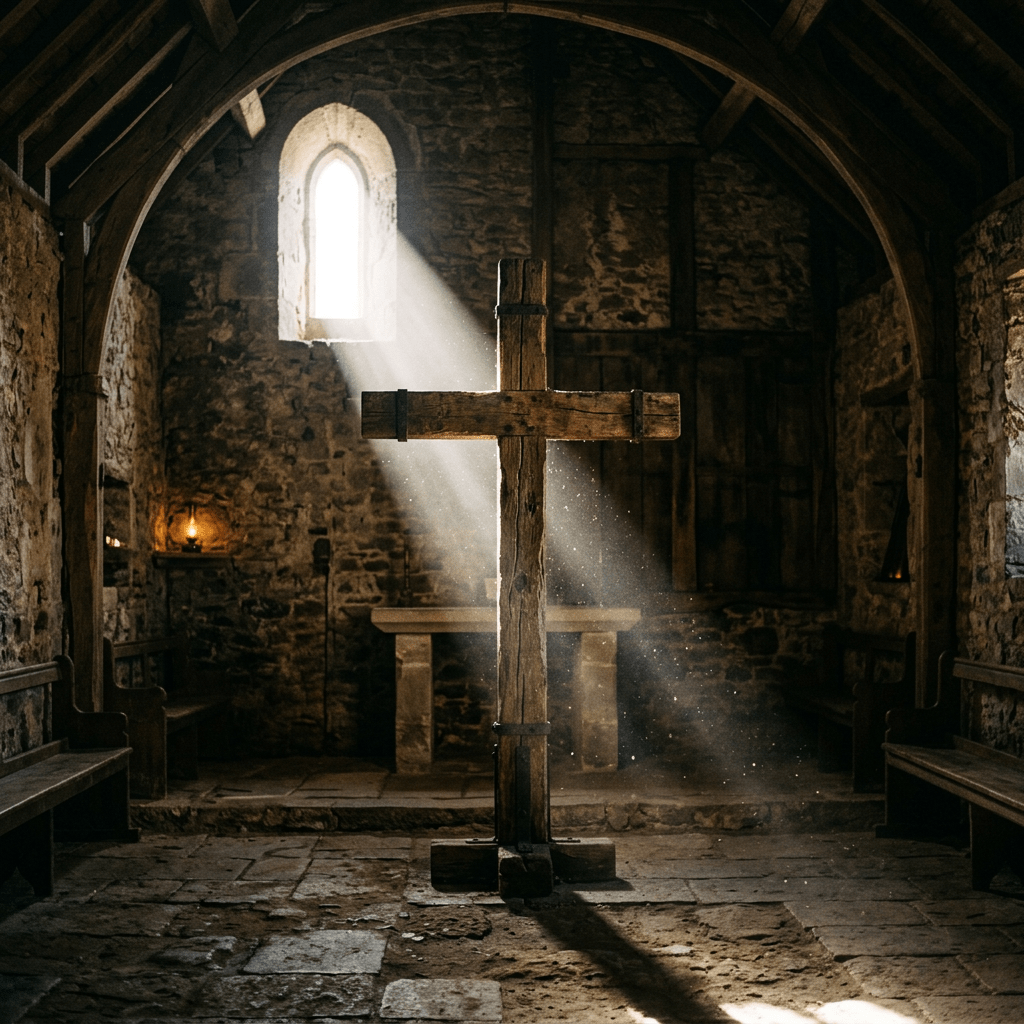
Sometime in the years 1205-1206 C.E., a young Giovanni “Francesco” di Pietro di Bernardone stumbled into a dilapidated Basilica of San Damiano, near Assisi, in the Umbria region of Italy.[1] Giovanni was raised in a wealthy family and had lived most of his 23-24 years enamored with partying, romance, and military service. In his late teens, he was knighted and went off to fight a war with a neighboring region. He ended up having to spend a year in captivity as a prisoner of war and came back to Assisi disillusioned and hopeless. He tried to go back to a soldier’s life, but before he could go off to war, he received a vision to go back to Assisi, where he found the basilica. Upon entering the basilica, he received a vision from the crucifix at the altar, which spoke to him, saying: “Francis, go and repair my house which, as you see, is falling into ruin.”[2]
Franciscan Spirituality in the High Middle Ages
Thus, young Giovanni the soldier became Francis the monk. He left behind his wealth and his position of power and went to live with lepers and the impoverished. Eventually, he began to accumulate followers, and the instruction to “repair my house” became an instruction for renewal of the Christian Church. The Franciscan movement had a tremendous impact on the medieval Roman Catholic Church and continues through today, with the last Pope, Jorge Mario Bergoglio (a Jesuit), taking the name Pope Francis.
With Francis of Assisi’s transformation came a form of spirituality that was attractive to those who were disillusioned by the pomposity of the wealthy during the High Middle Ages. Many distinctives mark the Franciscan view of Christian spirituality. Some of the most common traits derived from Francis’s writings are poverty and simplicity, humility, love for all creation, peace and reconciliation, and joy and gratitude. These traits characterized the initial group of Francis’s followers and other communities that developed after Francis.[3]
The earliest male followers of Francis developed the Order of Friars Minor, which initially was not a clerical group (Francis never thought himself worthy to be a priest).[4] Women formed a group called The Poor Clares, named after one of the women who followed Francis. Eventually, the Order of Friars Minor did embrace a clerical approach, but the movement initially remained wary of positions of power and influence.[5] Developing religious communities, called friaries, the Franciscans opted for a communal life that included serving smaller communities and developing personal relationships.[6] The friaries were not withdrawing from society (as did other monastic movements of the Middle Ages), but were engaged with people. As Francis engaged the world as a wandering preacher, restorer of chapels, and nurse for those that society rejected, so too did the Franciscan societies engage their local communities.[7]
Caring for the creation was also an important part of Franciscan spiritual life. Francis famously wrote the Canticle of the Creatures, which praised God along with his creation: Brother Sun, Sister Moon, Brother Wind, Sister Water, Brother Fire, and Mother Earth.[8] Francis taught his followers to sing this song and to care for the gift of creation. A story in The Little Flowers of St. Francis recalls Francis preaching to the birds, taking Matthew 28:19 to heart by going into the whole world.[9] Elsewhere, he preaches to a wolf terrorizing a village[10] and cared for turtledoves.[11] These stories led Franciscans to an early form of ecological care, which continues into modern Franciscan Spirituality.[12]
Lastly, one of the most unusual aspects of Franciscan spirituality is Francis’s acquiring of the stigmata. Francis received wounds on his palms, side, and feet, representing the wounds Jesus received in his passion. These were terribly painful, mystical wounds meant to bring faith out of Sunday Mass and into every day and every minute of the day – the believer is united with Christ in not just his glory but also in his pain and poverty of the cross.[13] Other notable medieval figures receiving the stigmata are St. Catherine of Sienna, St. Veronica Giuliani, and Blessed Margaret of Cortona.
Conclusion
Francis of Assisi was an intense influence in the High Middle Ages. His life and ministry continue to have a profound influence upon modern-day Franciscans and Poor Clares, who in turn minister to the world through their Franciscan spiritual distinctives. His call to restore a basilica is a greater call to renewal and restoration of faith to the greater church, both then and now.
[1] Biographical details obtained from The Brief Life of St. Francis | Franciscan Media, Franciscan Spirit, October 4, 2021, 42, https://www.franciscanmedia.org/franciscan-spirit-blog/the-brief-life-of-st-francis/.
[2] The Brief Life of St. Francis | Franciscan Media.
[3] Kohler Nicholas, “Franciscan Spirituality: Principles and Practices,” Franciscancaring, October 25, 2023, https://franciscancaring.org/franciscan-spirituality-principles-and-practices/.
[4] Norman Tanner, New Short History of the Catholic Church (New York: Burns and Oates, 2011), 121.
[5] Tanner, New Short History of the Catholic Church, 121.
[6] Tanner, New Short History of the Catholic Church, 121.
[7] Kohler Nicholas, “Lifestyle and Hobbies of a Friar of the Franciscan Order,” Franciscancaring, November 20, 2024, https://franciscancaring.org/lifestyle-and-hobbies-of-a-friar-of-the-franciscan-order/.
[8] Jon M. Sweeney et al., eds., The Complete Francis of Assisi: His Life, The Complete Writings, and The Little Flowers, Paraclete Giants (Paraclete Press, 2015), 317.
[9] Dom Roger Hudleston, trans., The Little Flowers of Saint Francis of Assisi, Kindle (New York: Start Publishing, 2012), 54.
[10] Hudleston, The Little Flowers of Saint Francis of Assisi, 68–71.
[11] Hudleston, The Little Flowers of Saint Francis of Assisi, 72.
[12] Kohler Nicholas, “Franciscans and Ecology: Caring for Creation,” Franciscancaring, December 3, 2023, https://franciscancaring.org/franciscans-and-ecology-caring-for-creation/.
[13] The Franciscan Friars, “A Friar’s NotesThe Stigmata: A Call to Live Our Faith Every Day,” A Friar’s Notes, The Franciscan Way, September 4, 2024, https://thefranciscanway.org/the-stigmata-a-call-to-live-our-faith-every-day/.

