

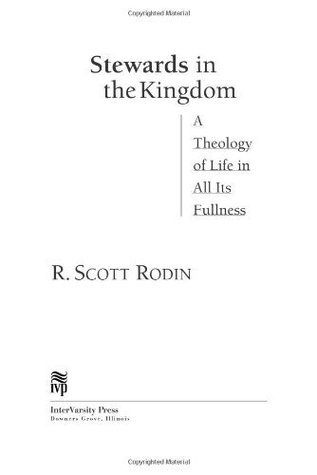
All references from Stewards of the Kingdom: A Theology of Life In All Its Fullness by R. Scott Rodin.
Stewards of the Kingdom provides a theology not just on money and giving, but, as the subtitle suggests, A Theology of Life in All Its Fullness. The fact that money and fundraising do not appear in the book in substance until the last half of the last chapter demonstrates that Rodin is providing a theology that demonstrates the full nature of the steward, which is an authentic life lived in devotion to Christ (11). Stewardship is not just about money and positions, but a standard for Christian ethics (11). While there is much to take from this book, this essay will focus on two main lessons: the four levels of the steward and the proclivity towards two kingdoms.
The four levels of the steward deal with relationships (29-30). They are relationships with God, self, others, and creation (30). These four levels and the relationships within those levels demonstrate a “witness to the triune, loving, and free creator” (82-83). Sin disrupted all four levels of the steward (92), and it is the reality of the world we live in (103). However, Jesus completed an act that allows us into the restoration of the four-level relationships, which requires both a joyful response and a sense of required work (114). In my teaching ministry, relationship stewardship must be kept in focus. When working through a biblical passage with my class, there is a need to incorporate the four levels and one kingdom thinking into my delivery.
The second lesson is related to the first and second kingdom thinking. Instead of one kingdom (the Kingdom of God), there is a prevalence in modern Christians to bifurcate their thinking into two kingdoms: one earthly and one spiritual (123). The worldly kingdom is where one categorizes their worldly matters (money, sex, career, etc.) in a separate life category from the spiritual kingdom (church, God, prayer, Bible, etc.) (127). The church encourages two-kingdom thinking when it treats sin as an abstract concept, devoid of spiritual ramifications (129). True stewardship is impossible while living in two kingdoms (152).
For my ministry as a teacher, a persistent reminder to my students is that followers of Jesus live in one kingdom, the Kingdom of God. Whether I am teaching from the Hebrew Scriptures or the New Testament, the curriculum must have a single kingdom focus. We have died to ourselves and now live in the newness of Christ (Galatians 2:20) in a single kingdom that is focused on the reality of Jesus and his vicarious atonement for the world (153-156).
In conclusion, these two lessons define my ministry and life. Living in the four levels of relationship in the Kingdom of God is what it means to be a follower of Jesus. Ministry must have the aroma of Christ-centered relationships that will draw those whom the Spirit is drawing into singular kingdom living.
 The Wandering Wesleyan