

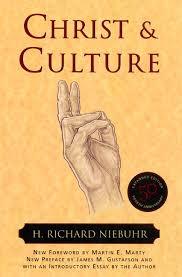
All references from Christ and Culture by H. Richard Niebuhr.
Niebuhr, in his book Christ and Culture, describes a problem with a dual demand on Christians from their faith and from the culture they live (2). Niebuhr observes that a Christian loves with agape love, hope, obedience to Christ, faith, and humility (28). Culture has its own traits that focus on the social (32), human achievements (33), as well as temporal, material, and conserved values (36-37). To answer this problem, Niebuhr provides five answers (40-43). These answers have two polar extremes and three median solutions. This essay will evaluate Niebuhr’s answers to the problem of Christ and culture and evaluate where they may fit in different cultural applications.
The first answer to the problem is the extremist who sees Christ against culture (45). This answer stands in the “uncompromising authority” of Christ and “resolutely rejects” any claim culture might have over the believer (45). The believer is not a part of the culture of the world, but the new society established by Christ (50). The extremist answer may have its place, despite multiple issues. Niebuhr uses Tertullian, who lived in an age of distinct persecution, as an example of this solution (51-52). This example draws one to modern examples of totalitarian cultures and Christian oppression, such as China, Iran, and North Korea. Christians may find this answer as the only way for them to remain obedient to Christ while living in a culture that is violently hostile to their faith. However, they must still avoid the pitfalls of the solution. The extremist should still embrace reason as well as revelation (76), they should still look for the good in their culture and not see it as completely sinful (78), they should avoid legalism and remember the grace that Jesus offers (79-80), and they should remain in the main currents of Christian doctrine and not reject fundamentals of the faith such as the Trinity (81). From Niebuhr’s description, extremists will find it difficult to live in a pluralistic, open culture.
At the other end of the spectrum is the culturalist (83). For them, the Christian faith is modified to find acceptance within the culture (84). The culturalist has no problem showing allegiance to culture along with allegiance to Christ (87). Christianity is another religion, and the church is an association within the culture (88-89). Culture doesn’t have a problem with Jesus, but with the dogmatics of church theology (93). The gospel, therefore, is seen as a universal message of the highest ideals for all humans, not a select few (105). Unlike the exclusivists, the culturalist elevates reason over revelation, thus denigrating scripture and tradition to a lower form of knowing God (110). Also redefined is the nature of depravity. Sin is defined as that which breaks the cultural laws, which may or may not be in line with Biblical moral standards. With Niebuhr’s description of the cultural Christian, one wonders if anything is left of the Christian distinctives described in chapter one when the answer is taken to its logical conclusion.
Niebuhr describes three middle alternatives. The synthesist views the problem from a “both-and” position as opposed to the “either-or” (120). Synthesists are at ease with social institutions and strive to obey cultural laws as good citizens while maintaining fidelity to Christ (143). The main problem with this view is that there is an inadequate representation of sin within the system (148). It is easily observed that in the institutions of church and state, while many good-willed people do good work, vast amounts of corruption and sin exist. The synthesist cannot provide an adequate answer to that obvious condition.
The second middle-ground answer, the dualist, can answer that problem. Dualists live within the paradox of living in a deeply fallen culture, yet serving a Holy God (150). Culture is corrupted, and dualists are at ease with that (153). They particularly pay attention to the paradoxes of law and grace as well as divine wrath and mercy (157). Breaking the law of God brings His wrath. However, through Christ, He provides grace and mercy. Dualists need to avoid the tendency to believe they are above the cultural laws and falling into a “cultural conservatism” (187). In America, this may be seen in the Christian Nationalist movement. The dualist must avoid this blending of politics and faith lest they lose the distinction of both.
The final answer provided by Niebuhr is the middle ground of the conversionist who is driven to transform the culture (190). The conversionist is more positive about culture (191) and is marked by three “theological convictions:” creation as an ongoing part of redemption (191-192), the fall of humanity and its corruption of creation (193-194), and, with God, all things are possible (194-195). For the conversionist, God has been active in creation and in corrupted humanity, dynamically transforming them. Niebuhr uses Augustine and Maurice as examples of conversionists, but one could also see the modern kingdom-based theology of third-wave charismatics (such as Ladd, Morphew, and Wimber) at home in this approach to Jesus and the culture.
In conclusion, Niebuhr does not land on one specific answer (230). The Christian answer to the Christ and culture problem is an ongoing conversation. With, perhaps the exception of the culturalist, in this author’s view, the extremist, the synthesist, the dualist, and the conversionist have a place in the conversation of Christ and culture. They are complementary answers as opposed to contradictory. Dependencies of different cultures and different mores within those cultures may dictate what answer or blend of answers the Christian may adhere to. In this author’s view, the culturalist compromises the essential transformative and distinct nature of the gospel to the point of losing its Christ-like flavor. The rest of the answers, however, do provide conversational starting points in dealing with the tensions between faith and culture.
 The Wandering Wesleyan