

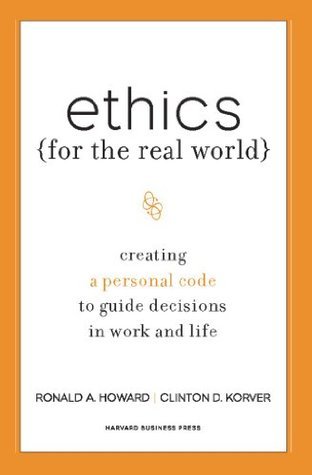
All references are from Ethics for the Real World: Creating a Personal Code to Guide Decisions in Work and Life (Kindle Edition) by Ronald A. Howard
The scenario: Murray went to a very busy Costco. As he unloaded his shopping basket into his car, he knew he was late picking up his daughter from soccer. Murray realized he had a bottle of Italian Seasoning that he had not paid for. Should he go back and pay for it, or go and pick up his daughter?
Mastering ethical dilemmas is a matter of ethical thinking and avoiding ethical compromise (pg. 2). Making good ethical decisions in small things will lead to sensitivity in all ethical issues (pg. 3). The authors presuppose that premastering ethical distinctions enables clarity in ethical thinking (pg. 2). If Murray has an established, ethical code, then he will have clarity in what to do about the unpaid item. The authors identify stealing, lying, and harming others as the most common ethical breaches, but they do not say why they are wrong (pg. 8). Answering the why question allows objective standards of ethical behavior and keeps ethics from straying into relativism.
There are three dimensions of ethical action: prudential (self-interest), legal (does it break the law), and ethical (personal ethical standards) (pgs. 35-36). Keeping the item without paying for it breaks the law and breaks Murray’s personal ethics. Prudentially, it could be in his self-interest to leave with the item unpaid and pick up his daughter. This action could also be against his self-interest in that he could be charged with shoplifting. Positive and negative ethics play in his decision. He should not (negative) steal. He should pick up his daughter on time (positive) (pg. 39). Is he making his decision based upon the right actions (pg. 40) or fear of negative consequences (pg. 41)? Lastly, is his rationalization and the excuse of picking up his daughter a way to avoid returning to the store and paying for the item (pg. 44)?
Murray has three legacies of “ethical voices” that will inform his choice (pg. 52). The first legacy is the religious legacy (pgs. 52-58). Murray is a Christian, and his religious legacy informs him that stealing is wrong. This negative imperative is more than a rule to be followed (pg. 53). For Murray, not stealing reflects a higher positive imperative to love God and love people (pg. 54). The authors state that religious guidance is vague at times and can diminish “skillful ethical thinking” (pg. 54). Murray sees clarity in his ethical thinking primarily due to his religious legacy. The dismissiveness of the authors to the religious legacy ignores the clarity that religious systems can give individuals.
Another legacy, the secular voice, will also inform him that stealing is wrong (pgs. 58-63). The secular voice looks at the consequences of action more than the actions themselves (pg. 58). In this case, the consequences of keeping the item might be very small, and the consequences unlikely. However, arriving late to pick up his daughter might have more definite consequences. The last legacy, work, is important to consider, as ethical decisions outside of work will necessarily affect his ethical decisions at his job (pg. 63). If Murray decides to keep the item without paying for it, does it become easier to take some pens from the office supply at work home for personal use? Or does returning and paying for the item encourage him not to take small things home with him?
Had Murray read our text, he would have developed his own ethical code by drafting and testing his standards, and refining his code (pg. 73). He could then move through the flow chart of decision-making to guide his ethical choice (pg. 155). Murray starts with the question, does he return to the store and pay for the item, and arrive late to pick up his daughter? Prudentially, returning to pay for the item or leaving both seems to be in his best interest. In the next step, Murray decides that keeping the item violates a negative and a positive imperative. Murray is also an action-based thinker in that the principles matter more than the consequences (pg. 105). He realized that keeping the item would be disobeying God’s commandment against stealing, which is unloving towards God. He also realized it would be an unloving example for his daughter and for the store. It would also be unloving to arrive late to pick her up. He decides to leave, pick up his daughter, and then go back to the store and pay for the item.
 The Wandering Wesleyan