


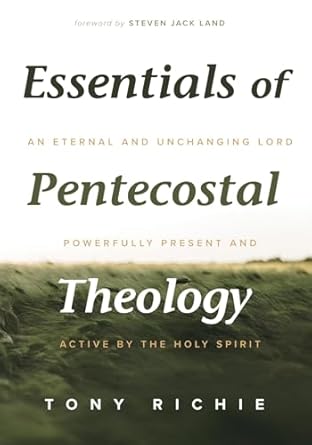
Tony Richie’s book Essentials of Pentecostal Theology: An Eternal and Unchanging Lord Powerfully Present and Active by the Holy Spirit attempts to answer the questions, “What is Pentecostalism?” and “What do Pentecostal Christians believe and practice?”[1] This quest for definition is challenging because Pentecostal theology is sometimes a moving target, with a broad range of “dramatic diversity” that crosses multidenominational, multicultural, and political lines.[2] Therefore, a comprehensive discussion of Pentecostal theology must be necessarily flexible.[3] Richie states: “Perhaps Pentecostalism can best be described as a movement, signifying that which is always in motion, even in transition, and characterized more by elasticity than staticity, more by fluidity than rigidity.”[4]
Richie attacks this quest to define Pentecostal theology by splitting his work into three parts. Part one is “Various Accents and Conflicts,” part two is “A Description, Not a Definition,” and part three is “Crucial Commitments.” Each part builds the case that Pentecostal theology in beliefs and practices can be defined and explained as a comprehensive theological understanding.
For the scope of this essay, for part one, I will only concentrate on chapter one, entitled “Representative Perspectives.” In this chapter, Richie covers the distinctives of a deep collection of Pentecostal thinkers. Those theologians covered are Walter Hollenweger, French Arrington, Hollis Gause, Steve Land, Frank Macchia, Estrelda Alexander, Leonard Lovett, Cheryl Bridges Johns, Lisa Stephenson, Samuel Solivan, Eldin Villafañe, Cecil M. Robeck, Amos Yong, and Veli-Matti Kärkkäinen. While not an exhaustive list, what is apparent in the writings of all of these theologians is that there is a diversity not only of perspectives but culture, ethnicity, politics, and language. As represented by these individuals, Pentecostal theology ranges from the traditional to the cutting-edge, but the emphasis is not incompatibility but community.[5]
For part two, Richie presents the theological guts of Pentecostalism. First, Pentecostal Christology (theology of the Christ, Messiah, Jesus). Here, in Hebrews 13:8 (echoing Malachi 3:6), the stress is the unchanging nature of Christ. Richie compares this with cessationists (those who believe the gifts, such as healing, prophecy, tongues, etc., have ceased with the end of the original Apostles). He states, “Cessationists emphasize changing times but Pentecostals emphasize an unchanging Lord.”[6] The signs and wonders of Jesus continue throughout the ages and into the modern church age as a pointer to the eschatological (study of the end times) Kingdom of God.[7] Jesus is the Messiah (Christ) who is living, unchanging, present, and active by the power of the Holy Spirit.[8] Out of this comes what Richie terms Spirit Christology, a “fluid term” that focuses on the humanity and divinity of Jesus and his life and ministry empowered by the Holy Spirit.[9]
Chapters five and six reflect on the theological framework of Pentecostal worship and prayer, respectively. Both subjects reflect the relational posture of theological thinking.[10] With worship, Richie echoes Gordon Smith by demonstrating worship as preaching the Word, participating in the sacraments (baptism, communion, and, for some, foot washing), and immediacy (experience) of the Holy Spirit.[11] Also essential to Pentecostal worship is the idea of mystery, that which is revealed by the Holy Spirit rather than something secret or unknown.[12] Gause is referenced in his elements of Pentecostal worship: rapture (joy), rapport (love between God and His worshipers), and proleptic (the already of redemption and the not yet of the coming Kingdom).[13] Pentecostal prayer, like worship, is a distinct and essential element of its theology. Experiencing God with the significant distinctives of praying in the Spirit (tongues) and altar prayer (coming to the altar to experience God).[14]
Chapters seven and eight focus on the concept of the whole gospel (Jesus as Savior, Sanctifier, Holy Spirit Baptizer, Healer, and Soon Coming King).[15] Chapter seven focuses on the biblical and classical aspects of fullness or being filled. The concept of filling is linked to “vocational endowment.”[16] This theme continued past the Apostles and into the church age with the concept of discipleship, which describes ascending “growth and progress.”[17] Also, historically, the Wesleyan model of “Christian Perfection” or “Entire Sanctification” continues the Pentecostal idea of “Full Salvation.”[18] This Wesleyan concept, often misunderstood, is not speaking of perfect obedience to a set of rules and laws but a fullness of salvation of loving God and fellow humans.[19]
This fullness extends to the theological concept of conversion beyond the believer coming into a relationship with God through Jesus. Richie states: “Conversion involves making peace with God (reconciliation) through faith in Jesus Christ and becoming a new creation by the Spirit’s life-changing power… For Pentecostals salvation is also freedom, recovery, and victory. Salvation is freedom from bondage, recovery from disaster, and victory over evil. In short, salvation is deliverance” (italics original).[20] Continuing the theological theme, sanctification is addressed, and here, John Wesley has again influenced Pentecostal Theology. Pentecostal views on sanctification involve doctrine and experience, where the believer is continually being formed in Christ to live holy lives.[21]
Spirit Baptism (addressed significantly in part three) and Divine Healing are also theological concepts distinct to Pentecostal Theology. Divine Healing is a unification of the physical and the spiritual. The spiritual is not separate from the physical but is deeply intertwined with our physical beings.[22] Divine healing is also eschatological in that it points towards God’s eternity.[23] Eschatology for the Pentecostal is essential because, like other concepts discussed thus far, it combines pneumatology, mission, and service.[24] Richie ends chapter eight with a five-point eschatology that emphasizes divine sovereignty, synergy, and imminence of both the spiritual and the material – God will set it all to right for eternity.[25]
In Part Three, “Crucial Commitments,” Spirit Baptism is further distinguished by divine subsequence (Baptism of the Holy Spirit is subsequent to salvation)[26] to empower for service[27] with godly love.[28] According to Pentecostal theology, the initial evidence of Spirit Baptism is speaking in tongues.[29] Initial evidence speaks to the testifying of the experience of Spirit baptism to glorify God.[30] Richie finishes the book with an exposition of speaking in tongues and its significance to salvation and Pentecostal theology.
Reading Richie’s book taught me two main concepts. The first is Spirit Christology. I have studied Christology and Pneumatology (study of the Holy Spirit), but I had never thought to combine the two into one theological concept. The Holy Spirit’s presence in Jesus’ ministry, especially in his destiny to the cross and resurrection, intertwines the two disciplines. What I also found interesting was that Spirit Christology was used by the Apostolic Fathers through to modern theologians to defend the divine nature of Jesus.[31] Spirit Christology affects the Pentecostal in worship “with an almost intoxicating, and certainly exhilarating, sense of God’s manifest presence in Jesus through the Holy Spirit.”[32]
The second concept I learned from the book was the doctrine of Divine Subsequence. Not being a Pentecostal, I initially found it strange to have a doctrine to describe the chronological location of Spirit Baptism. But when Richie stated that conversion was not an ending point but an embarking on a more extensive journey, it resonated with me.[33] The unification of Soteriology (the study of salvation) and Pneumatology fits nicely into my Wesleyan / Kingdom Theology framework. Seeing it as an “initiating experience” brings the believer, no matter how long they have been a follower of Jesus, into a fresh experience with the Holy Spirit enhancing their spiritual walk.[34]
For my ministry, I will use what I have learned in two ways. First, I will have a deeper understanding of how the classic systematic categories of Pneumatology, Soteriology, and Christology combine. When writing sermons and Sunday School classes, I can see the text in a brighter light, more focused on the theological integration of categories instead of strict separation. Practically, it will help my audience see the working of the Holy Spirit not just in the expression of gifts but also in the life and ministry of Jesus and their own salvation testimonies. Challenging my Sunday School class and the congregation to bring multiple theological threads together will allow them to grow deeper in their understanding of their faith.
The second thing that will affect my ministry is the need for a full gospel when I am engaged in evangelism. For instance, when I am ministering to the motorcycling community through the Christian Motorcyclists Association, my message should not be singularly focused on delivering a conversion-centered message but expanded to include the workings and power of the Holy Spirit. A full gospel is not just an understanding and agreement with Jesus as Savior. It allows the Holy Spirit to guide the evangelistic conversation in a way that will demonstrate the power of the Holy Spirit and the holiness of God.
[1] Tony Richie, Essentials of Pentecostal Theology: An Eternal and Unchanging Lord Powerfully Present & Active by the Holy Spirit (La Vergne: Wipf and Stock Publishers, 2020), 11.
[2] Richie, 13.
[3] Richie, 13.
[4] Richie, 22.
[5] Richie, 61.
[6] Richie, 115.
[7] Richie, 115.
[8] Richie, 121, 125.
[9] Richie, 127.
[10] Richie, 137.
[11] Richie, 140.
[12] Richie, 148.
[13] Richie, 150.
[14] Richie, 183.
[15] Richie, 216.
[16] Richie, 222.
[17] Richie, 228.
[18] Richie, 232.
[19] Richie, 242.
[20] Richie, 242.
[21] Richie, 248.
[22] Richie, 257.
[23] Richie, 259.
[24] Richie, 264.
[25] Richie, 266.
[26] Richie, 275.
[27] Richie, 298.
[28] Richie, 308.
[29] Richie, 321.
[30] Richie, 334.
[31] Richie, 127.
[32] Richie, 131.
[33] Richie, 275.
[34] Richie, 293.
 The Wandering Wesleyan