

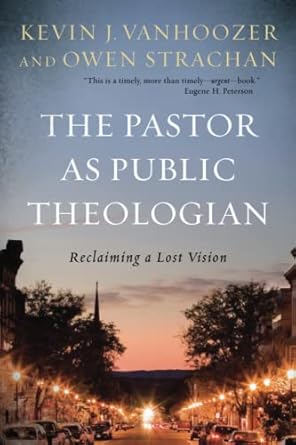
In his introduction to the book, Vanhoozer contends that pastors have primarily abandoned their function of delivering theology in a public setting. Specifically, he states that the “underlying conviction is that theological minds need to return to where they belong: in the body of Christ.”[1] The problem is that, while tied up with a multiplicity of demands, pastors put theology aside, which is ultimately detrimental to the church body. This “lost vision” leaves theology to the academy while ignoring the church and broader society.[2] Vanhoozer states that the purpose of the book is “to argue, first, that pastors must be theologians; second, that every theologian is in some sense a public theologian; and third, that a public theologian is a very particular kind of generalist.”[3]
The critical part of this purpose is the public nature of theological discourse. The hard part is taking theology out of the academy and into the pulpit so that theology can be delivered publicly to a broader non-academic audience.[4] However, the author’s premise is that pastors have historically been theologians who have spoken publicly of their theology and built people up in their faith with this publicly spoken theology.[5] Public theology is “theology that addresses common concerns in an open forum, where no particular creed or confession holds pride of place” and “is first and foremost a reaction against the tendency to privatize the faith.”[6] This is why the authors contend the pastor-theologian, must be a type of generalist who can go wide and deep in bringing the mind of Christ to the body of Christ.[7]
The authors divided the book into two parts with two sections each. Strachan wrote the first part, with two chapters outlining the history of the pastorate from biblical (chapter 1) and historical (chapter 2) perspectives. Vanhoozer wrote the second part, developing the systematic theology of the pastor (chapter 3) and the practical aspects of the pastor-theologian. Starting with history, Strachan argues that the pastorate is linked strongly to the Old Covenant triune roles of priest, prophet, and king. The priest was the mediator between God and the people[8], the prophet was the voice of the truth of God to the people[9], and the king was the wisdom leader of the people[10]. For the New Covenant, these three roles no longer point to obedience to the Law but to Jesus.[11] Thus, the New Covenant pastor “proclaims the gospel of grace in Christ to a people who desperately need it” (priest),[12] leads the congregation with humility (king),[13] and feeds their congregation “a steady diet” of the message of truth (prophet).[14]
From a historical perspective, the role of the pastor was once steeped in theology (with examples of Irenaeus,[15] Chrysostom, and Augustine).[16] However, during the Middle Ages, the theological role moved to more academic circles (Anselm and Aquinas)[17] and out of the local pastoral role. The Reformation’s focus on Biblical teaching brought theological discourse back into the pulpit.[18] Later, the Puritans continued this, seeing “pastoral work was not an escape from theological work but the call to instantiate truth in the life of the church.”[19] However, this changed as “the nineteenth century wore on and the twentieth began, pastors yielded to academics as thought leaders.”[20] Thus leading to the problem at hand.
Vanhoozer moves on to the next section and argues that pastor theologians “exist to communicate and disseminate this new evangelical mood: being-in-Christ.”[21] The world is filled with gloom and despair; people need a reason not to fall into acedia (defined as a type of existential malaise or listlessness).[22] This mood or message necessarily indicates proclaiming “what God has done, is doing, and will do in Christ.”[23] It is more than just knowledge but also a greater understanding of the meaning of life.[24] This proclamation is bathed in God’s word (scripture), the world and culture surrounding us, and words about this world.[25] By building biblical literacy, relating biblical principles to real-world situations, and effectively communicating this message, the public theologian fulfills the mandate of the Gospel.
The fourth chapter is focused on the praxis of being a pastor-theologian because theology itself is not “an end unto itself.”[26] Pastors are who they are because they work with people and “exist to edify people in Christ,”[27] and build Christ’s church.[28] This is done through four “artistic” expressions of the pastor theologian: the evangelist (proclamation of the Gospel), catechist (teaching the Gospel), liturgist (worshiping the Christ of the Gospel), and apologist (demonstrating the authentic Gospel). Each of these celebrates the Greatest Commandment of Mark 12:30: to love God and love people.[29] Finishing the book, Vanhoozer provides a fifty-five-point summary thesis on the pastor-theologian.
Lastly, at the end of each chapter, two to three reflections from different pastors expand Vanhoozer and Strachan’s work. While space does not allow a complete overview of these reflections, one is an exemplary addition to the book. Jim Samra’s “A Practical Theology of Technology” is a brilliant addition to Strachan’s biblical overview of the pastoral role (chapter 1). His main point is that, left unaddressed, people will use technology like a “sheep without a shepherd,” he sees his job as a pastor to help his congregation think biblically and theologically about technology.[30]
I was unfamiliar with several concepts and terms. For this essay, I will concentrate on three. First is the idea of the “organic intellectual.” Vanhoozer defines “organic intellectual” as “neither a genius—an individual thinker alone with their own brilliant thoughts, detached from everyone else—or a member of an elite intelligentsia,” but someone who “articulates the needs, convictions, and aspirations of the social group to which they belong.”[31] What Vanhoozer is getting at is that pastors who are organic intellectuals respond to their congregations with deep and thoughtful theology but also on a level that is accessible and practical. It adds to another concept in the book that the pastor-theologian is a generalist who can cross many theological, political, cultural, and philosophical topics relevant to the audience (congregation) they are addressing. As Vanhoozer further states, the “organic intellectual” helps people to read culture in light of biblical revelation.[32]
The second concept I learned from the book was the set of Indicative and Imperative moods. The indicative mood sets out to declare what is. It indicates what biblical truth is and who God is.[33] It is the art of proclamation, which aims to deepen an audience’s experience of God’s word.[34] The imperative, then, is what the audience, the congregation, is to do with that imperative declaration.[35] Pastors who only declare the truth (indicative) but do not provide the application of the truth (imperative) cease to be organic intellectuals and are aligned with the inaccessible academic intellectual realm.
Last, the concept of the pastor as an artisan resonated with me. I knew the individual categories Vanhoozer pointed out (evangelist, catechist, liturgist, apologist), but I had never put them all together as the generalist role of the pastor. The indicative categories of evangelist (declaring and proclaiming the gospel) and catechist (teaching biblical doctrine and theology) flow from the pulpit naturally. However, the liturgist (worship) and apologist (demonstration) are profoundly imperative – using the indicative information for imperative application. This is how the organic intellectual pastor challenges the congregation to grow deeper into a life in Christ.
Taking all that I have learned from the book, I will apply my discoveries in several ways. For this essay, I will concentrate on what I deem to be the two most significant changes, emphasizing putting into practice what Vanhoozer and Strachan have proposed in theory. First, I must continue to go deep with biblical study for my Sunday School classes. Those who attend my class on Sunday mornings are not very biblically literate – but they want to be. By offering them deeper biblical study and theological concepts, they will continue to grow in their understanding of the Bible and what it means to be “in Christ.” Currently, we are studying the Gospel of Mark. Through this study, my class is learning not just about Jesus and his ministry but also how to study the Bible independently. Second, as a fill-in preacher for my pastor, my sermons should be filled with theological depth. I should be careful to balance biblical theological concepts and discourse with practical application. The sermon should aim to increase the congregation’s biblical literacy and awareness of biblical unity.[36] The sermons should, at the same time, have practical applications. In short, they should be imperative as well as indicative.[37] My sermons must be thoughtfully delivered, emphasizing biblical revelation and practical application. Theological terms should not be avoided but explained. The congregation will respond and leave the service with a greater understanding of the subject and how to live it out.
[1] Kevin J. Vanhoozer and Owen Strachan, The Pastor as Public Theologian: Reclaiming a Lost Vision (Grand Rapids, Michigan: Baker Academic, 2015), 2.
[2] Vanhoozer and Strachan, 4.
[3] Vanhoozer and Strachan, 5.
[4] Vanhoozer and Strachan, 12.
[5] Vanhoozer and Strachan, 15.
[6] Vanhoozer and Strachan, 17.
[7] Vanhoozer and Strachan, 25.
[8] Vanhoozer and Strachan, The Pastor as Public Theologian.
[9] Vanhoozer and Strachan, 44.
[10] Vanhoozer and Strachan, 48.
[11] Vanhoozer and Strachan, 50.
[12] Vanhoozer and Strachan, 51.
[13] Vanhoozer and Strachan, 53.
[14] Vanhoozer and Strachan, 57.
[15] Vanhoozer and Strachan, 71.
[16] Vanhoozer and Strachan, 73.
[17] Vanhoozer and Strachan, 76.
[18] Vanhoozer and Strachan, 77.
[19] Vanhoozer and Strachan, 82.
[20] Vanhoozer and Strachan, 88.
[21] Vanhoozer and Strachan, 107.
[22] Vanhoozer and Strachan, 106.
[23] Vanhoozer and Strachan, 109.
[24] Vanhoozer and Strachan, 112.
[25] Vanhoozer and Strachan, 113.
[26] Vanhoozer and Strachan, 139.
[27] Vanhoozer and Strachan, 142.
[28] Vanhoozer and Strachan, 144.
[29] Vanhoozer and Strachan, 140.
[30] Vanhoozer and Strachan, 68.
[31] Vanhoozer and Strachan, 24.
[32] Vanhoozer and Strachan, 117.
[33] Vanhoozer and Strachan, 108.
[34] Vanhoozer and Strachan, 152.
[35] Vanhoozer and Strachan, 122.
[36] Vanhoozer and Strachan, 186.
[37] Vanhoozer and Strachan, 186.
 The Wandering Wesleyan