

Book Review: Restoring the Lost Kingdom: A Biblical-Theological Look at 1 Timothy 2 by Dénes House
Having studied theology and the Bible for many years, I need to be reminded (with some frequency) that the conclusions I reach through my study have real-world implications that affect people in real-world situations. This is the case when addressing the issue of women in leadership roles within the household, the church, and society. The conclusions may be valid and biblical, but that doesn’t mean that those conclusions won’t impact people and relationships. Therefore, when doing biblical and theological study, I need to be careful not only with how I study and what conclusions I come to but also need to be careful with how I deliver those conclusions.
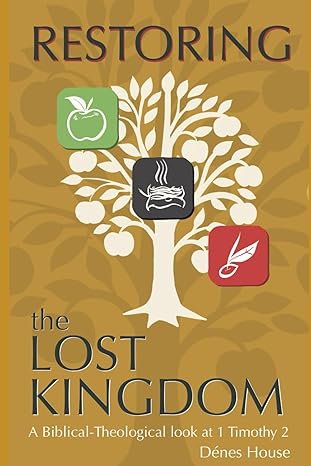
Such is the case with Dénes House’s first (and I hope not last) book, Restoring the Lost Kingdom: A Biblical-Theological Look at 1 Timothy 2.[1] House takes on the issue of the leadership role of women in the church (primarily) and the home (secondarily).[2] These issues cannot be left in the stuffy offices of academia because they profoundly impact the spiritual lives of every Christian. House does a great job of reminding us of that truth and makes every attempt to reveal the real-world implications of his conclusions.
To start, House looks at the difference between biblical and Systematic Theology. Both need each other, but that is often forgotten. His chapter on the subject reminds me of Scot McKnight’s excellent book, 5 Things Biblical Scholars Wish Theologians Knew. To be sure, House’s book is Biblical Theology, but he draws deeply from the wells of systematic theologians in the process.
House’s understanding of the first three chapters of Genesis is central to the book. The first two chapters tell us how God designed and intended humans to be, and Chapter 3 tells us how it turned out when humans decided to go their own way. Through careful textural study, House concludes that the subordination of women to men only came after the fall and was not a part of God’s initial design of humanity. The entire issue of women’s leadership is bound to these initial observations.
That leads to House’s second central theme: Scripture passages are to be studied in context. Every word in scripture should be understood in the context of its sentence. Every sentence must be understood in the paragraph it is in. Every paragraph must be understood in the context of the section of the book it is in. Every book must be understood in the context of the entirety of Biblical narrative. House states: “We need to let the whole Bible determine how we interpret tough passages, rather than deciding on an interpretation of a tough passage and reading the rest of the Bible through the lenses of our interpretation. I contend that this is what we have done with this passage for nearly 2000 years, and it’s time to stop.”[3]
Another theme addressed in the book is a proper understanding of primogeniture—the idea that what comes first rules over what comes second. House expands the concept beyond household traditions to include societal structures. The first is always the best. The latter is always inferior. However, House observes that God in the Old Testament and Jesus in the New Testament turn primogeniture upside down. Isaac, not Ishmael, is chosen. David, not his older brothers, is chosen. The first will be last and the last first. God’s reversal of primogeniture is all over scripture and church history. In reviewing the historical attitudes of church leaders and women, he observes, “This history of a negative, biased view of women has to be raised precisely because the chief argument against women serving in Church leadership, or having a relationship of mutuality in the home, is that the Church has always practiced gender relations this way.”[4]
House concludes that women’s church and house leadership equality are entirely biblical. His journey to this conclusion is similar to mine. House also touches on the theme of unity in the book, which is an essential place for him to land. For a long time, like House, I thought that the egalitarian side of the isles was fraught with those who eisegetically imported their feminist views into scripture and ignored the text’s plain statements. For me, it wasn’t until I heard Craig Keener and read his book Paul, Women, and Wives: Marriage and Women’s Ministry in the Letters of Paul that I came to the same conclusion. With these issues, we must not castigate those who hold opposing positions as not being fully Christian.
I recently had a conversation with a seminary student studying at a very progressive seminary about this issue. Through some dubious sources, she concluded that Paul either didn’t write what he wrote or that the texts themselves should be removed from scripture. I was able to lead her through an exegesis of 2 Timothy 2 that exposed the weakness, not of her conclusions but of her methodology. However, what was disheartening was how she felt about complementarians—that they were all misogynistic anti-feminists. I told her that was certainly not the case. If we start with an understanding that we are just trying our best to understand and be faithful to the biblical text, no matter what conclusion we come to, we can do so with kindness and charity.
Lastly, I want to address the title of the book. One of the conclusions in the book is that one day, there will be a restoration of the Kingdom God initially set up. While that is undoubtedly true, and I am in complete agreement, he tips his toes over the edge of Kingdom Theology without taking the plunge. If one wants to delve further into the depths of Kingdom Theology, I suggest Goerge E. Ladd’s work, especially Gospel of the Kingdom: Scriptural Studies in the Kingdom of God and The Presence of the Future: The Eschatology of Biblical Realism. Also, I would suggest the work of Derek Morphew, especially Breakthrough: Discovering the Kingdom. Having stated that, overall, this is a superb book and well worth the read.
[1] In full disclosure, I have been friends with Dénes for nearly 20 years and have drawn upon his insight into theology and scripture more than a few times.
[2] Leadership roles of women in society, while not a focus in the book, can be implied by House’s conclusions.
[3] Dénes House, Restoring the Lost Kingdom: A Biblical-Theological Look at 1 Timothy 2, 2024 184-185.
[4] House, 208.
 The Wandering Wesleyan